
Mastering the skill of writing assignments is one of the most essential academic skills for every student. While most focus on what is contained in the body of the assignment, students frequently overlook the significance of the first page (or cover page), as it is often where a lecturer or examiner gets their initial impression of the assignment. A properly formatted and well – structured first page can significantly impact how the rest of the assignment will be viewed. By presenting a professional, academically credible, well-organised, and detail-oriented front page to an assignment, a student is likely to receive greater academic rewards, and the final grade will also reflect a positive image of the student.
The Importance of the First Page
The first page of any assignment should be concise and easy to understand, and have an organised framework to guide the reader’s attention. In an academic environment, many students mistakenly believe the front page is simply an administrative requirement and therefore do not put time and effort into ensuring that their front page has been correctly structured. A well-structured first page is essential for the following reasons:
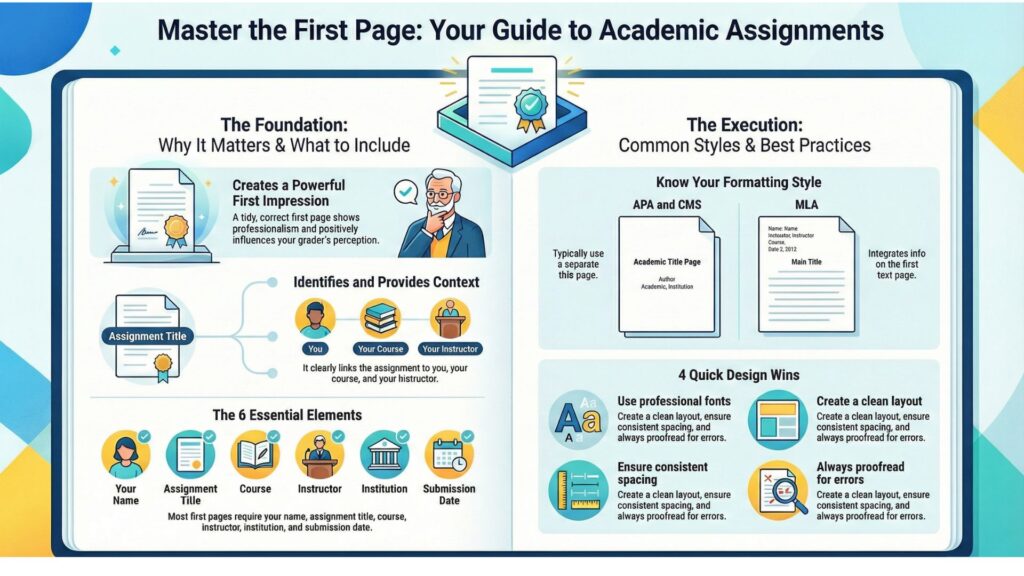
Creates Strong First Impression
The initial impression that the examiner develops upon receiving an assignment occurs when they review the first page of your assignment. If the first page is formatted correctly and tidy, it will produce a positive impression of your professionalism and attention to detail as an academic professional. Alternatively, if the first page is disorganised or presents information in an unclear or unprofessional manner, then the reader (examiner) is likely to develop a negative opinion of your assignment prior to even reading its content.
Identifies the assignment clearly
The first page of an assignment identifies the assignment to the examiner, linking your assignment to your academic identity with both the course and your instructor.
Provides Context to the reader
A well-written first page provides, in the assignment title and subject title of the assignment, sufficient context for the reader so that their experience with the assignment and reading in general before reviewing the main content of the assignment.
Demonstrates Adherence to Academic Standards
Most institutions require specific formatting requirements for the first page of any academic assignment. Therefore, adhering to these professional conventions demonstrates an understanding of and respect for the academic institution.
What are the elements of the First Page?
While the requirements for the first page may be different depending on the academic institution or faculty member, the following items will generally be included on any first page of an academic assignment:
1. Title of the Assignment
The title of the assignment should be written in a simple and concise manner that accurately conveys what your assignment is about. It will typically be placed close to the top of the first page of the assignment, centered, and usually in bold.
The title should be as brief as possible while still providing enough information for someone to know what your assignment is about from the first impression.
2. Your Full Name
Your full name should be clearly visible on the first page, as it typically will appear either under the title or below your Online Submission area, depending on your required formatting style.
3. Course Name and Code
Including both the course name and course code will provide the instructor with everything they need to place this assignment into the correct context of their course, which makes it easier for the instructor to maintain records when they have many students to handle. This information is typically located near your name or in the area of your institution’s information.
4. Instructor Name
Including the name of the instructor helps the student direct their assignment specifically to that individual and also helps them organise their assignments from the many students in each class.
5. Institution Name
Including the name of the College/University you are attending, as well as possibly the Discipline/Field of Study, formally identifies the academic institution with a formal record of the credit requirements for that particular academic programme.
6. Date of Submission
The date the assignment was submitted is important for record keeping, which allows the professor to easily compare the due date with the date the assignment was submitted. Different countries have different formats (e.g., DD/MM/YYYY; MM/DD/YYYY).
Additional elements may be included if requested, such as the student’s registration number, assignment number, or the program name.
Formatting Styles for the First Page
Each discipline and institution has its own specific formatting style for the first page(s) of documents, including, but not limited to, the Title Page Format.
Three of the most commonly used formats are:
MLA Style
1. The first page of an assignment generally does not have a separate title page. The required information is included in the top left corner of the first page of text. This includes, but is not limited to, the Author’s Name (Student Name), Instructor’s Name (Teacher), Course Name and Code (Class), and Date assigned. The Title of the Assignment is centered above the Beginning Paragraph.
2. While some of the elements are different, MLA First Page formatting has some of the same features:
• 1-inch margin
• Double-spaced text
• Author in the upper left corner
• Title center/aligned and capitalised properly
• Beginning paragraph begins after title with one-half inch indentation
APA Style
1. APA is commonly used in the Social Sciences. The APA First Page will have a title page.
2. The first page includes:
• Running Head and Page Number
• Title in Centre and Title Case
• Author’s Name (Student Name)
• Institution/University (Student Facility)
• Course Information
• Instructor’s name
• Due Date
3. APA emphasises clarity and professional presentation, with all items centered and aligned.
CMS (Chicago Manual of Style)
1. CMS also uses a Title Page on occasion.
The first page of a Chicago-style document generally contains:
• The title of the assignment, written in capital letters, centered about a third of the distance down the page
• Subtitle(s) if applicable
• Your full name (all four parts)
• Course name and number
• Name of the instructor (with title)
• Date (complete date including year), which appears below the instructor’s name
Although CMS allows a bit more flexibility in spacing than MLA or APA, it still requires that the first pages be presented neatly and professionally, as this will add to the overall effect of your assignment.
How to Design the First Page to be Impactful?
Here are a few suggestions on how you can use design elements on your first page(s) to increase both clarity and impact:
Select Professional Font Styles
For example: Times New Roman (or equivalent) or Arial/Calibri are recommended font style size 11 or 12 font size. Avoid decorative font styles (e.g., ‘Comic Sans’) since these can distract the reader from your work or give it an unprofessional appearance.
Create an Organised Layout
Creating a layout that has equal amounts of left-aligned and center-aligned text will help to ensure that your first page has a professional appearance. Avoid cluttering the first page(s) with items that do not contribute to the presentation of your work.
Check Your Spacing and Alignment
Your first page must have consistent double-spaced text with standard margin widths of approximately one inch. Check that the first page is aligned properly to ensure it is readable and the entire page gives the impression of a polished document.
Correct All Errors
Check all pages for any spelling, formatting, or factual errors before submitting your assignment. Errors appearing on the first page(s) may detract from the quality of the other pages of your assignment.
Conclusion
The purpose of the first page of an assignment is not simply to fulfill a formality, but rather to serve as the initial entry point of your academic work. By incorporating some basic components – Title, Student Name, Course Information, Instructor Information, College/University, Submission Date, etc.
A professionally designed and accurately formatted first page enhances the overall presentation of the student’s assignment and further demonstrates the student’s commitment to producing quality work with accuracy and care.
By using the suggested ideas presented above, students can create a quality first page of their assignments and be confident that it will improve the quality of their assignment rather than diminish it.Also Read: Thesis Writing Service