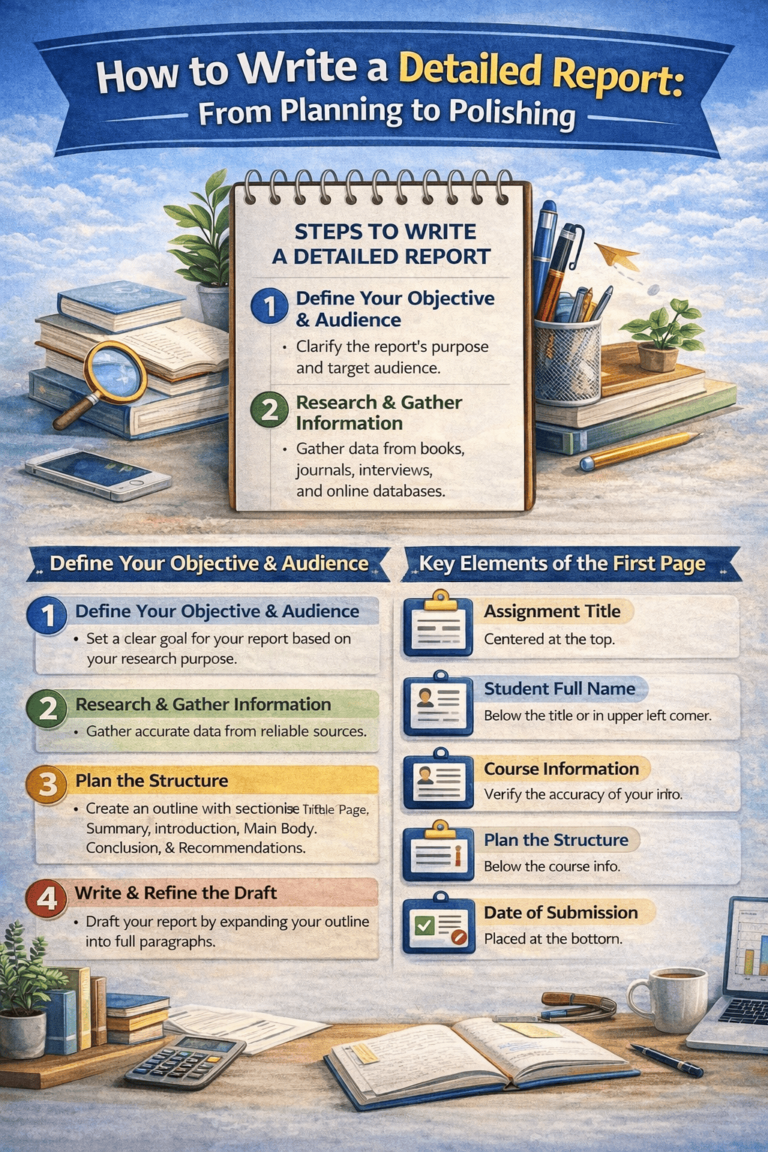

A detailed report represents critical research and professional competency. Reports provide readers with a comprehensive understanding of the information presented in a coherent format. In addition to reporting the details of a specific situation or event, effective reporting includes critical analysis of the data, the methods used in collecting it, and recommendations based on the findings of the research study. Report writing is used in all areas of business and industry when writing a report on a research study, project evaluation, or analysis of a business process.
What are the steps to write a detailed report?
A report can be defined as a formal document used by individuals for the purpose of providing information in a systematic format for a specific audience, with a defined objective. When writing reports, emphasis should be placed upon demonstrating that the presented evidence/data has credibility, and the reader will be able to navigate through and understand the major points that the writer is attempting to convey.
1. Define your objective and intended audience.
To be able to write a quality report, you need to be very clear on what you would like to communicate to your audience and who the intended reader of your report is.
Not only will the purpose of the report be the basis for determining the type of report that you are going to write (e.g., informational report, analytical report, progress report, or technical report), but it will also provide you with an outline of what will need to be included in the report. To ensure that your report meets the expectations of your audience and is relevant to their needs, choose language and details that are appropriate for your audience.
Your audience should know what to expect from you when you are meeting all of their responsibilities and expectations, but they also need to be aware of your goals and objectives when completing the project.
The way a report is prepared may differ depending on who the report is for. For example, a technical report that is intended for engineers will contain different words and data visualisations than a progress report for a project in college. Knowing the purpose of a report helps with planning and helps to guarantee that the report meets the audience’s needs.
2. Researching and Gathering Information
After completing the understanding of the report’s purpose, the next step is to prepare and conduct research to find accurate information. The information used for the report must be accurate and depend on verifiable data. When conducting research, be sure to gather data from different groups of sources (i.e., used via journal articles, government documents, research surveys, and/or conduct your own interviews with Subject Matter Experts or via your own management system) and host (e.g., institutional) records to provide a basis for your research findings.
To improve the readability of your report, you may use charts, graphs, tables, etc., as forms of supplemental support for your research findings, thus increasing the likelihood of the reader citing the support material you provided with your research.
Additionally, when structuring your research, it should be arranged in a consumable manner for future reviews to aid in the writing of your report.
3. Planning the Structure
Planning the structure of the report provides a guide to your work. Each report is generally structured with the following standard format:
- Title Page
- Table of Contents
- Executive Summary
- Introduction
- Main Body
- Conclusion
- Recommendations
- References List
Outlining allows you to see how each piece ties to the next and how detailed each element should be.
4. Writing the First Draft
You may start working on the first draft of your documentation by translating your outline into written paragraphs now that you have completed your research and established your framework. Write the introduction first. The reader will learn what to anticipate from the report in this part.
The document should be divided into subsections (where applicable) to provide ease of reading and readability. In the main body of the document, you should use facts, conduct the needed analysis, and provide supporting evidence (when it is available) to communicate to your audience clearly and logically. You can include visual elements such as charts and tables wherever appropriate to further support the content being presented.
The draft for the conclusion and recommendation should provide a summary of the major findings with a recommendation for how to respond to those findings.
Also Read: How to Write a Hypothesis? Step-by-Step Guide with Examples
5. Using Clear Language
It is highly recommended to keep the report template as simple as possible while ensuring that it also meets the criteria of clarity and ease of understanding for the intended audience, as well as to provide valuable information to the audience.
Avoid using excessive complexity within the sentence structure and technical language, unless you have adequately described the information previously. In addition, creating shorter paragraphs and using specific words enhances the readers’ ability to read the report and stay focused on the content of the report.
6. Proofreading and Editing
Your final report will come as the result of the editing and proofreading processes. When editing your draft, the first step is to ensure that all the information is presented in such a way as to demonstrate a logical flow of ideas based on the reporting goal. The second step is to ensure that all conclusions in the report are based on the evidence gathered in the reporting process. Finally, you must proofread for grammatical and typographical errors.
Proofreading will help you build a report that contains no errors and therefore becomes more effective at communicating information and ideas to the reader.
7. Final Presentation and Formatting
The formatting and presentation of the report are the last two steps of the process. Formatting ensures that the final report is consistent in format (e.g., font type, font size, type and spacing of paragraphs, size of headings, etc.) throughout. It should also ensure that all tables and figures are properly labelled. The correct format and layout for the report allow the reader to better comprehend the organisation of the report and how to navigate its contents.
In addition, you must create a reference list. This list should contain complete bibliographic entries for each reference you used to create the final report.
Conclusion
The writing of a detailed report can take many months of hard work, patience, and devotion. It begins with an understanding of the purpose and audience of the report; next, you’ll establish the information you’ll use to provide the report with integrity; finally, you’ll establish a structure for the report (i.e., using flow and consistency). These are three key foundational steps in writing a report. You create a professional, informative, and thorough report by writing clearly, revising adequately, and polishing your final product.