
The report is an important part of academic and professional life because it allows individuals to document information systematically, clearly, and indiscriminately so readers can make informed decisions about how to utilise that information for their benefit. Reports provide an opportunity for people to communicate with one another regarding similar subjects without bias.
Key Areas Highlighting the Importance of Report Writing
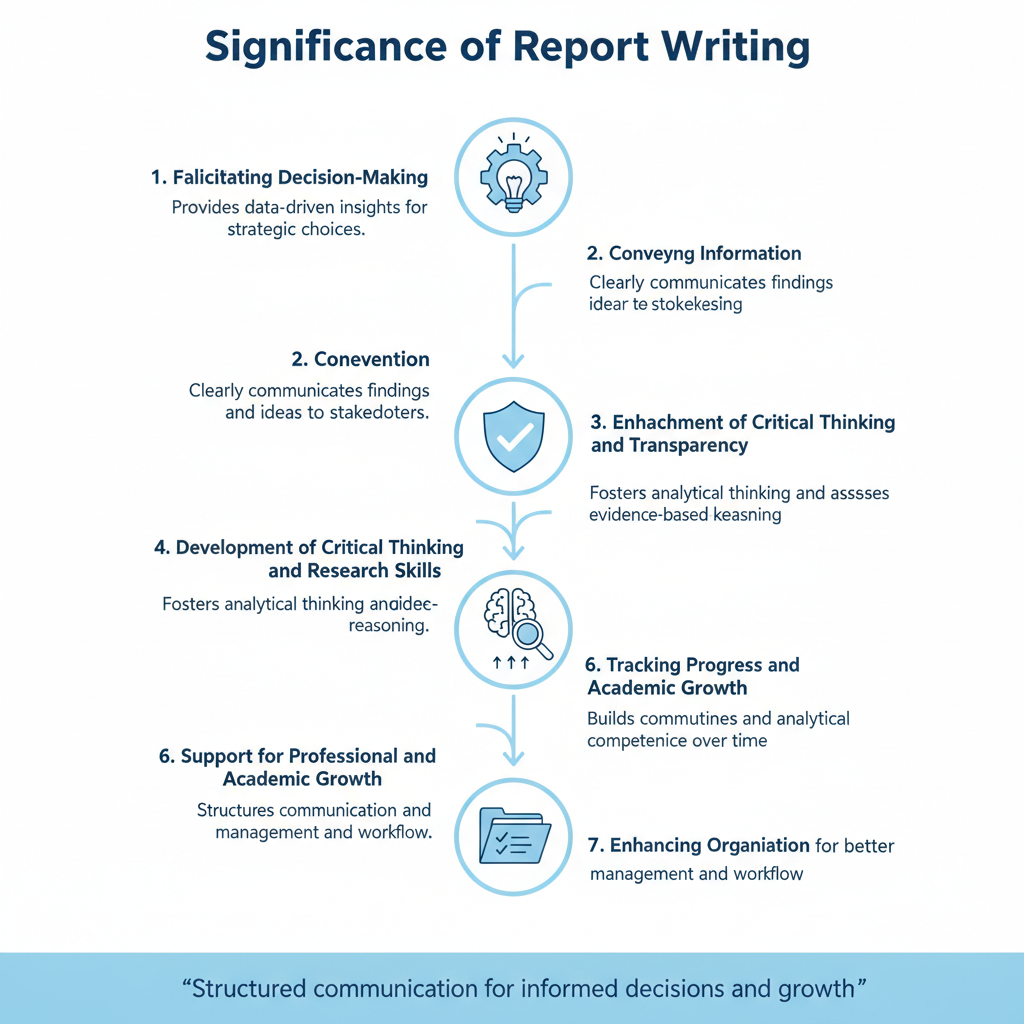
The importance of report writing can be understood through several key areas, these collectively explain why report writing remains as an essential form of formal communication.
1. Facilitating Decision-Making
When writing a report, the writer creates a formal record or reference to a series of events, findings, or results associated with a particular project or programme. Unlike informal conversations or stories, reports typically follow a set format that consists of an introduction, main body, conclusions and recommendations. The set format allows readers to access and understand the data contained in the report in a logical and orderly manner.
2. Conveying Information
The primary function of report writing is to assist in providing clarity and conciseness to the reader when conveying information that may be complex in nature. Both academic and professional communication must clearly articulate to the reader that there is no ambiguity, in order to minimise misunderstandings.
When writing a report in a classroom, students can display their understanding of a topic, summarise their research and observations about the subject, or reflect on the results of their experiment. Being encouraged to structure their knowledge systemically will aid students in developing their writing capabilities, as well as enhancing their ability to synthesise information.
In business, reports are written to communicate with the many people that could potentially become involved with your business, including your internal employees, external customers, investors and regulatory agencies. The format in which a business report is written allows the managers of an organisation to present a summary of market trends, operational problems, and performance metrics, to enable all stakeholders to act with confidence and clarity.
3. Enhancement of Accountability and Transparency
Reports ensure greater accountability and provide evidence to interested parties (stakeholders and market regulators) of the integrity of the businesses’ actions. By creating and maintaining a written record of their transactions, actions, and results, a report creates an electronic or paper trail that any interested party may review to establish whether or not a business has acted ethically.
When it comes to an organisation’s operational reports, they can show how various departments contribute to the overall success of the organisation. For example, if there is a project that did not achieve the intended target or goal, the report will explain why the end result was different from what was expected. When stakeholders receive the reports, they help create transparency within an organisation and provide information that clears any possible falsehoods or misunderstandings.
When it comes to academic institutions, teachers and evaluators will use reports in order to assess a student’s performance fairly. Reports provide educators with an objective means of evaluating students as opposed to a subjective means of evaluating students.
4. Development of critical thinking and research skills
While report writing does involve documenting facts, it also includes providing a critical analysis and interpretation of the facts presented. Writers have the responsibility to evaluate and discern reliable sources, assess evidence, determine if there is a pattern, and finally, come to a logical conclusion based on the data. This process develops analytical and critical thinking skills to a much greater extent than before, which are important skills for both an academic setting and the job market.
5. Tracking Progress and Evaluation
Correctly written reports give us the information we need about our business performance or progress with a project over time. There are many types of reports that you may create, depending on your industry, company, or department.
Reports also allow employers to keep track of the quality of work that is being done by employees and/or contractors, and they allow employers to measure employee productivity by comparing the productivity of all employees working in the same department or region. The measure of employee productivity will allow employers to determine how many employees need to be hired, scheduled, or promoted.
6. Support for Professional and Academic Growth
Reports are critical for an individual’s continued professional development. Individuals who possess good writing skills are better equipped to create clear, cohesive, well-organised reports that present logical arguments. In addition, individuals who are able to successfully create clear, concise, persuasive reports are more likely to get hired by employers across a wide variety of industries.
7. Enhancing Organisation and Efficiency
In addition to establishing credibility when creating reports or submitting them for publication, an academic researcher may leverage their ability to produce a well-documented and detailed research report by ultimately publishing their research through journal and conference presentations.
For example, there are significant benefits to reporting for planning purposes.
Reports (as opposed to email reminders) allow teams to keep track of what they need to do while allowing them to manage the time spent on those tasks.
A progress report allows individuals and teams to stay focused on what needs to be accomplished in order to achieve their ultimate goals.
As an example, the executive summary provides a condensed or simplified version of the report to allow decision-makers to understand the overall message of the report without having to read the entire document, thereby saving time and increasing productivity, particularly where time is limited.
Conclusion
To sum up, report writing represents an essential means of communication to facilitate decision-making, track progress, measure performance, and promote accountability and growth. With its structured presentation of information, report writing has allowed individuals to make informed decisions (and track those decisions), allowing for both the assessment of progress and effective communication with a variety of stakeholders.
Report writing provides individuals with an enhancement of their professional credibility; provides a foundation for organisations to operate transparently; enhances the ability of individuals to think critically and to enhance the professional image of both groups and organisations within a specific sector; and report writing will continue to be important for all areas of life. Report writing gives all individuals an opportunity to develop an organised, informed, and meaningful workplace in the world today.
Also Read: Types of Primary Research Crucial For Report Writing & Dissertations