
Many students must have experienced the “appear or disappear” situation when formulating a hypothesis for a new research venture. You are certainly not alone if you embark on a new research project and are unsure of where to start. Formulating a hypothesis is a vital component of a research project as it clearly indicates what you will set out to discover through a series of research actions. Hypothesis formulation should take place before any data can be obtained and even before an experiment is conducted.
Formulating the hypothesis is one of the most important aspects related to the coursework assignments and dissertation or research proposal requirements at UK universities.
Definition of Hypothesis
A hypothesis is a clear and concise worded prediction of the result of a research inquiry. It is a statement of what is expected, which is revealed in investigating the relationship between a series of variables. A hypothesis, therefore, is neither a prediction nor a guess but, instead, an observation made out of existing theory, data revealed through background reading, and existing research discoveries.
For research done in institutions of learning, especially with the background information regarding the UK educational setting, the hypothesis can be: It ought to be one that can be ascertained or disproven by proven methods of research, such as the performance of an experiment, survey, observation, or analysis. Effectively written hypotheses assist in identifying the purpose of doing the research or analysis.
Hypothesis Testing – Variables Involved
Variables are the building blocks of all mathematical models, hypotheses, and conclusions drawn in any science, including psychology. Most hypotheses describe a relationship between variables:
- Independent Variable: The variable whose value will be intentionally altered or controlled within the experiment.
- Dependent Variable: It defines what variable will be tested or measured.
For instance:
Engaging in outdoor activities improves mental health.
In this research, the independent variable is the time that is spent outside, while the dependent variable is the level of emotional well-being. It is assumed that the time spent outside will impact the level of emotional well-being.
Kinds of Hypotheses with Examples
Hypotheses can also be classified based on the structure, intentions, or methodologies involved in testing the hypotheses. These classifications are not mutually exclusive, such that a single hypothesis belongs to more than one category.
- Simple Hypothesis
A simple hypothesis investigates the connection between one independent variable and one dependent variable.
Examples:
Increased study time leads to better performance in examinations.
Reducing screen brightness may increase the battery life of a mobile.
- Complex Hypothesis
Complex hypotheses involves more than one independent or dependent variable.
Examples:
Study duration and support are some of the factors that may affect the performance of students.
The living conditions and employment position influence the level of life satisfaction.
- Null Hypothesis
The null hypothesis is represented by the letter H0, and it is defined as stating that there is no relationship, link, or effect of the variables.
Examples:
There is no relationship between caffeine intake and the level of concentration.
Learning efficiency is unaffected by listening to music.
- Alternative Hypothesis
The alternative hypothesis (H₁ or Hₐ) contradicts the Null Hypothesis and asserts the existence of relationship between variables.
Examples:
Listening to music encourages concentration.
Listening to music affects study work efficiency.
- Logical Hypothesis
A logical hypothesis is formulated on the basis of logic, as opposed to factual or tangible evidence.
Examples:
The sharp-toothed species would be carnivorous.
Life forms existing on high-gravity planets find life difficult on Earth.
- Empirical Hypothesis
An empirical hypothesis depends on observation, experimentation, and facts.
Examples:
One can prevent infection by frequently washing hands.
Increased worker breaks lead to increased productivity.
- Statistical Hypothesis
A statistical hypothesis is based on the use of sample data with the intention of making inferences about a population.
Examples:
The average amount of sleeping time reported among university students in the UK is less than seven hours.
A few people in the world are born with the left side of the brain.
Knowing about these categories will assist you in selecting the right hypothesis for your study.
A Good Hypothesis Should Be Specific
A hypothesis serves as a strong starting point for research. The following are the elements that must exist in the hypothesis:
Clear Cause-and-Effect Relationship
A hypothesis must be able to explain the relationship between a variable and another variable. For this, the usage of the “if-then” statement is possible.
A hypothesis has to be measurable in a way that the procedures used in the study or research are relevant. You should be able to collect facts that may or may not confirm or validate the hypothesis.
Replacing “easy” and “accurate
Hypotheses should be clearly and directly phrased. It is true that ambiguously labeled hypotheses can confuse and often cloud the topic of investigation.
Ethical Responsibility
A hypothesis should never state immoral means of testing it. The moral issues will mostly arise in research work involving human subjects, animals, and any kind of confidential data.
Therefore, the above features will ensure the validity and efficacy of the hypotheses you put forward for the conduct of ethical research.
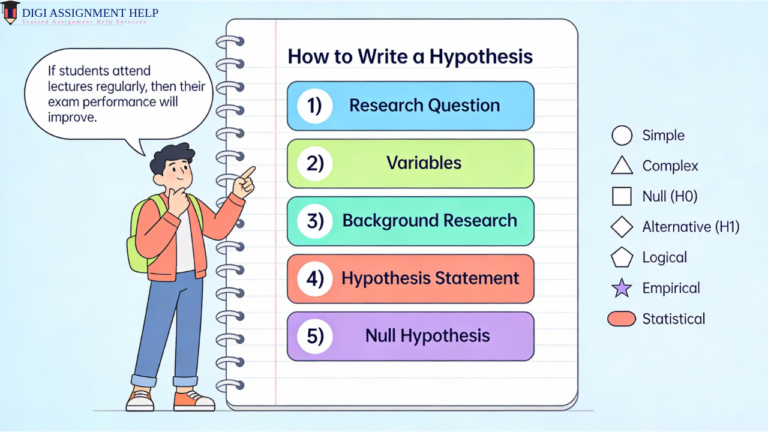
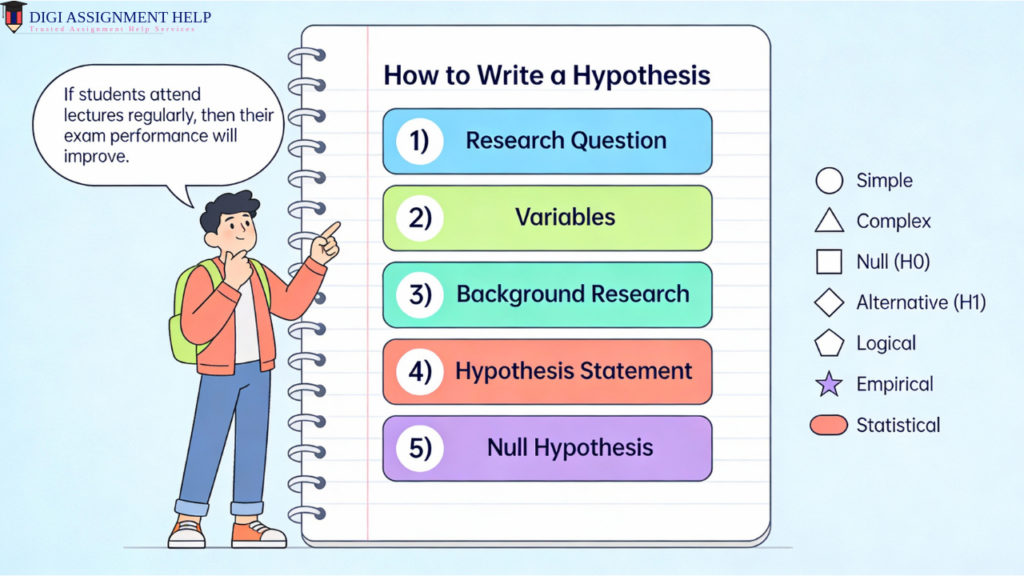
How to frame a Hypothesis?
Hypothesis formulation is not an activity performed in an unstructured manner. There are some steps you have to follow:
Develop Your Research Question
You start with a research question that you are focused on or trying to answer.
Figure Out the Academic Research
Can participation in lecture activities affect academic success?
Conduct Background Research
Academic literature analyses helps in better understanding of the field, making one know the subject. All duplicate work shall be avoided.
A major point that needs to be noted in this stage is that it is necessary to identify the important variables and calculate the test statistics.
Formulate Your Hypothesis
Articulate your research question in a predictive statement.
Attending the lectures is also beneficial in terms of academic performance.
Refine the Statement
It should also be ensured that the hypotheses include:
- Target population
- The expected outcome
Use If
Use `if`the structure to clearly express cause and effect relationships.
Note:
- If they attend classes, their performance during the exams would be good.
Formulating a Null Hypothesis
In quantitative research, a null hypothesis is required in conducting a statistical test.
Examples:
H₀: Lecture attendance has no effect on performance in examinations.
H₁: Lecture attendence has a positive effect on the pass rate.
Following these guidelines, you will be able to ensure that you formulate a research oriented hypothesis that is completely oriented towards research.
Characteristics of a Good Hypothesis
- A good hypothesis should always have these characteristics:
- Testable: Has measurable outcomes
- Falsifiable: Testable by Evidence
- Conclusion: Made clear with very little detail
- Relevant: Focuses on a prominent research problem or issue
These conditions ensure the validity of the paper. These conditions also establish a link between the title of the paper and the paper. Satisfying these conditions improves the
Conclusion
Hypothesis plays an important part in the academic research work, which helps in the evaluation of data. Understanding the way of preparing a hypothesis and the types of hypotheses will definitely have a positive effect on the research work being performed by the students. Hypothesis has been described in examples and processes that can aid the students.
However, in case you still have issues with the process involved in writing a hypothesis, there are resources available in the university that can help you with the development of your ideas to make sure your work meets the UK university standards. Writing a hypothesis can help you create sound university conclusions.